 English
 русский
 Español
Email us now!
Email us now!
Industry News
 2026.11.13
 Industry News
Factories that handle sheet materials and light fabrication often need cutting tools that move freely around large workpieces or tight workstations. A battery jig saw provides that freedom by removing the restriction of a power cord while still delivering controlled reciprocating action. Overseas purchasing teams reviewing tools for production or assembly lines usually examine how the design supports daily use rather than occasional tasks. Clear information on mechanism, power delivery, and handling helps buyers match the tool to their actual cutting requirements.
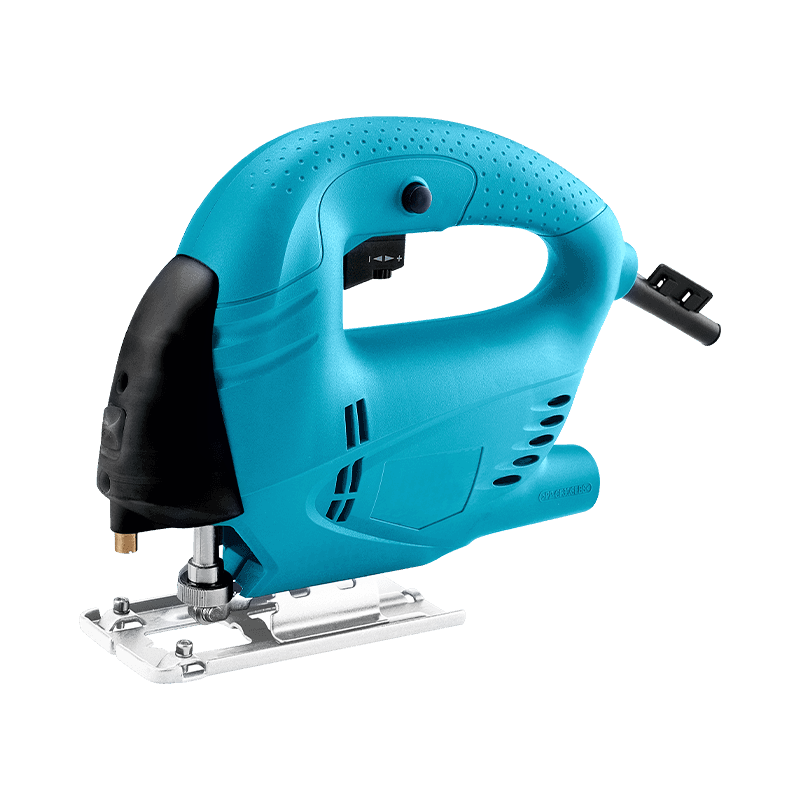
The reciprocating drive sits at the heart of every battery jig saw. An electric motor converts rotary motion into rapid up-and-down blade movement, allowing the tool to follow curved lines, create internal openings, or make straight cuts in wood, plastic, thin metal, and composite panels. Because the power pack travels with the tool, operators can reposition themselves or the workpiece without searching for nearby outlets or managing trailing cables.
Lithium-ion battery packs supply the energy for modern battery jig saw models. These packs maintain steady voltage under load and accept recharges on standard chargers used across many cordless tool platforms. Facilities already running drills or drivers from the same brand family can often share packs, which simplifies inventory and reduces the number of different chargers kept on site. Capacity choices let buyers select lighter packs for frequent repositioning or higher-capacity packs for longer continuous runs.
Weight distribution receives careful attention in the tool’s layout. Designers position the battery toward the rear or under the main grip so the center of gravity stays close to the operator’s hand. Soft-grip surfaces and balanced housings help reduce strain during extended sessions. Variable-speed triggers allow a slow start for accurate blade placement, then higher speed once the cut is established. These handling details become important when operators use the tool for several hours across a shift.
Blade selection shapes the results a battery jig saw can deliver. Fine-tooth blades produce cleaner edges on sheet metal or laminated panels, while coarser patterns clear wood chips more quickly. Bi-metal constructions resist heat buildup and maintain sharpness longer when the work mixes different materials. Quick-release clamps let operators change blades without extra tools, keeping production moving when material types change within the same workflow.
Base plates on most models tilt for bevel cuts, commonly up to 45 degrees in either direction. Dust-blowing ports or vacuum connections help keep the cut line visible, and compact LED lights illuminate the work area under dim shop lighting. Stroke rates typically span a wide range, giving users the ability to match speed to material thickness and hardness. Steady feed pressure and proper workpiece support further improve cut quality and reduce vibration that can wander the line.
In metalworking environments a battery jig saw commonly trims light-gauge sheet, aluminum extrusions, and thin-walled tubing. Operators start cuts from an edge or from a drilled pilot hole, making the tool useful for notching and fitting components. Furniture and wood-product lines rely on it for curved profiles and hardware openings, while plastic fabrication shops use it on acrylic and polycarbonate sheets where edge quality matters. Assembly stations that install panels or enclosures also keep the tool available for on-the-spot adjustments.
The cordless format proves especially practical when work moves between fixed stations or when large assemblies cannot be brought to a stationary saw. Operators walk around the workpiece or reach into partially assembled structures without managing power cords. This flexibility supports both dedicated cutting tasks and quick modifications that arise during assembly sequences. Buyers mapping tool use against their floor layouts often find the battery jig saw fills gaps left by larger fixed equipment.
Recommended Products
Contact Information
Mob: +86-13486952519
Whatsapp/wechat: +86-13486952519
E-mail: [email protected]
Add: Dawu Village, Huajie Town, Yongkang, Jinhua City, Zhejiang Province, China
Product
Contact Us!
Copyright © by Yongkang Zhongyuan Industrial & Trade Co. Ltd. Rights Reserved.

Curve Cutting Saw Factory