 English
 русский
 Español
Email us now!
Email us now!
Industry News
 2026.08.28
 Industry News
Cordless cutting tools rely on stored electrical energy rather than a continuous cord connection. A battery electric saw draws power from a removable lithium-ion pack that feeds a compact motor, which in turn spins a circular blade or drives a chain. The design prioritizes consistent torque under load while keeping the overall package portable for work on framing lumber, sheet goods, or light structural materials.
Most current models employ a brushless direct-current motor. Permanent magnets sit on the rotor while windings on the stator receive timed pulses of current from an electronic controller. Because no carbon brushes contact a commutator, friction losses drop and the motor runs cooler under sustained cuts. The controller monitors rotor position through sensors or sensorless algorithms and adjusts the phase of the current to maintain efficient magnetic alignment.
This arrangement produces high starting torque that helps the blade reach working speed quickly and hold that speed when the cut encounters denser grain or knots. Gear reduction between the motor shaft and the blade arbor lowers rotational speed while multiplying torque, matching the mechanical needs of wood cutting without requiring an oversized motor.
The battery pack connects through a standardized interface that supplies both high current and data signals. Voltage platforms commonly range from 18 V or 20 V max systems up through higher-voltage packs for larger blades. Capacity, expressed in amp-hours, determines how many cuts a single charge can support under given material conditions. Advanced packs incorporate cell-balancing circuits and thermal sensors so that the tool can limit current draw if temperature rises beyond design limits.
Some control schemes apply regenerative braking after the trigger is released. Kinetic energy remaining in the spinning blade converts back into electrical energy that partially recharges the pack, extending the number of cuts available per charge cycle. Electronic braking also shortens the time the blade continues to rotate once the cut ends.
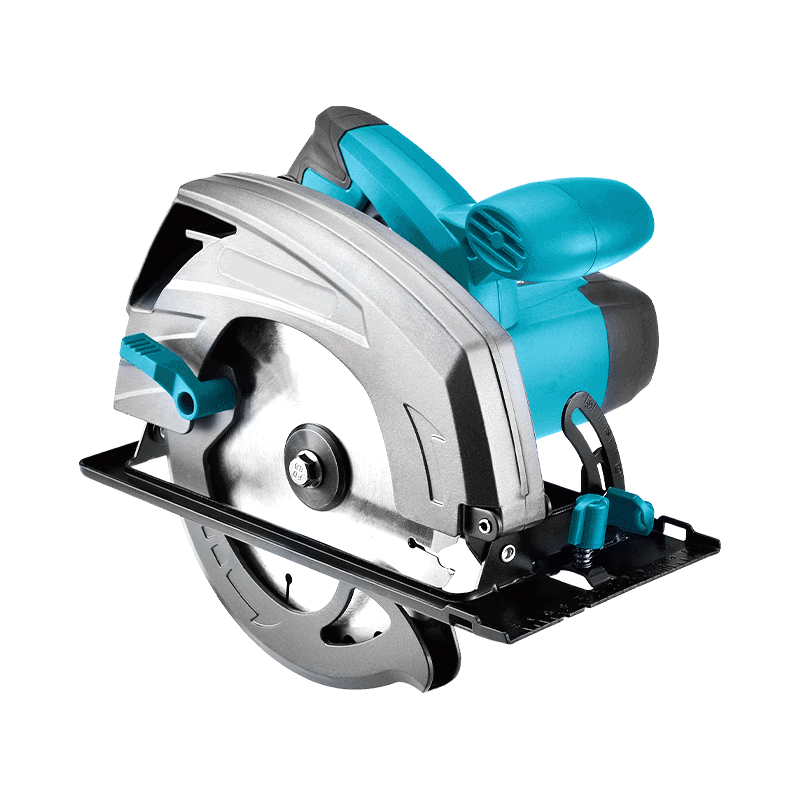
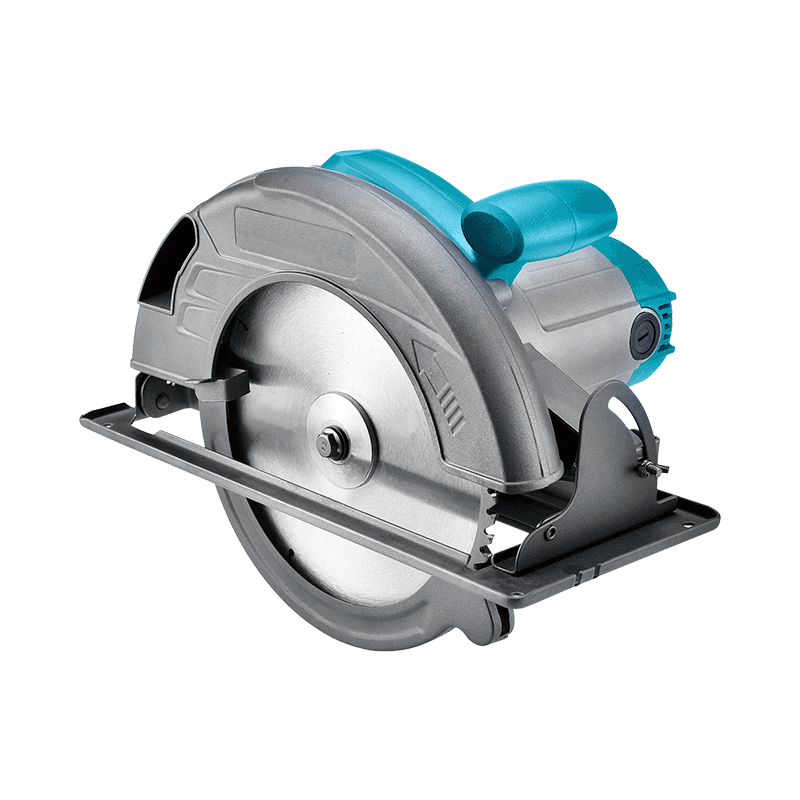
In a typical circular configuration the motor drives the blade either directly or through a short gear train. Blade diameters of 6½ inches or 7¼ inches remain common for general carpentry because they balance cutting depth with tool weight. Depth-of-cut adjustment raises or lowers the shoe relative to the blade, while a bevel mechanism tilts the shoe for angled cuts. Positive stops at frequent angles speed setup for repeated miters.
Chip ejection paths and optional dust ports help clear the kerf so the blade does not bind. An upper guard covers the unused portion of the blade, and a lower retractable guard swings clear during the cut then returns once the cut finishes. Some housings incorporate a rafter hook that allows temporary storage on framing members without setting the tool on the ground.
The housing combines magnesium or reinforced polymer sections to keep mass low while protecting internal components from jobsite impacts. Balance points sit close to the handle so that one-handed or two-handed operation feels stable during long rips or crosscuts. The battery mounts at the rear or base in a position that does not shift the center of gravity excessively as the pack is swapped.
A battery electric saw therefore integrates energy storage, efficient electromechanical conversion, and precise mechanical adjustment into a single portable unit. The combination of brushless motor control, managed battery discharge, and adjustable cutting geometry allows the tool to perform repeated cuts across common construction materials while remaining independent of fixed power outlets.
Recommended Products
Contact Information
Mob: +86-13486952519
Whatsapp/wechat: +86-13486952519
E-mail: [email protected]
Add: Dawu Village, Huajie Town, Yongkang, Jinhua City, Zhejiang Province, China
Product
Contact Us!
Copyright © by Yongkang Zhongyuan Industrial & Trade Co. Ltd. Rights Reserved.

Curve Cutting Saw Factory